
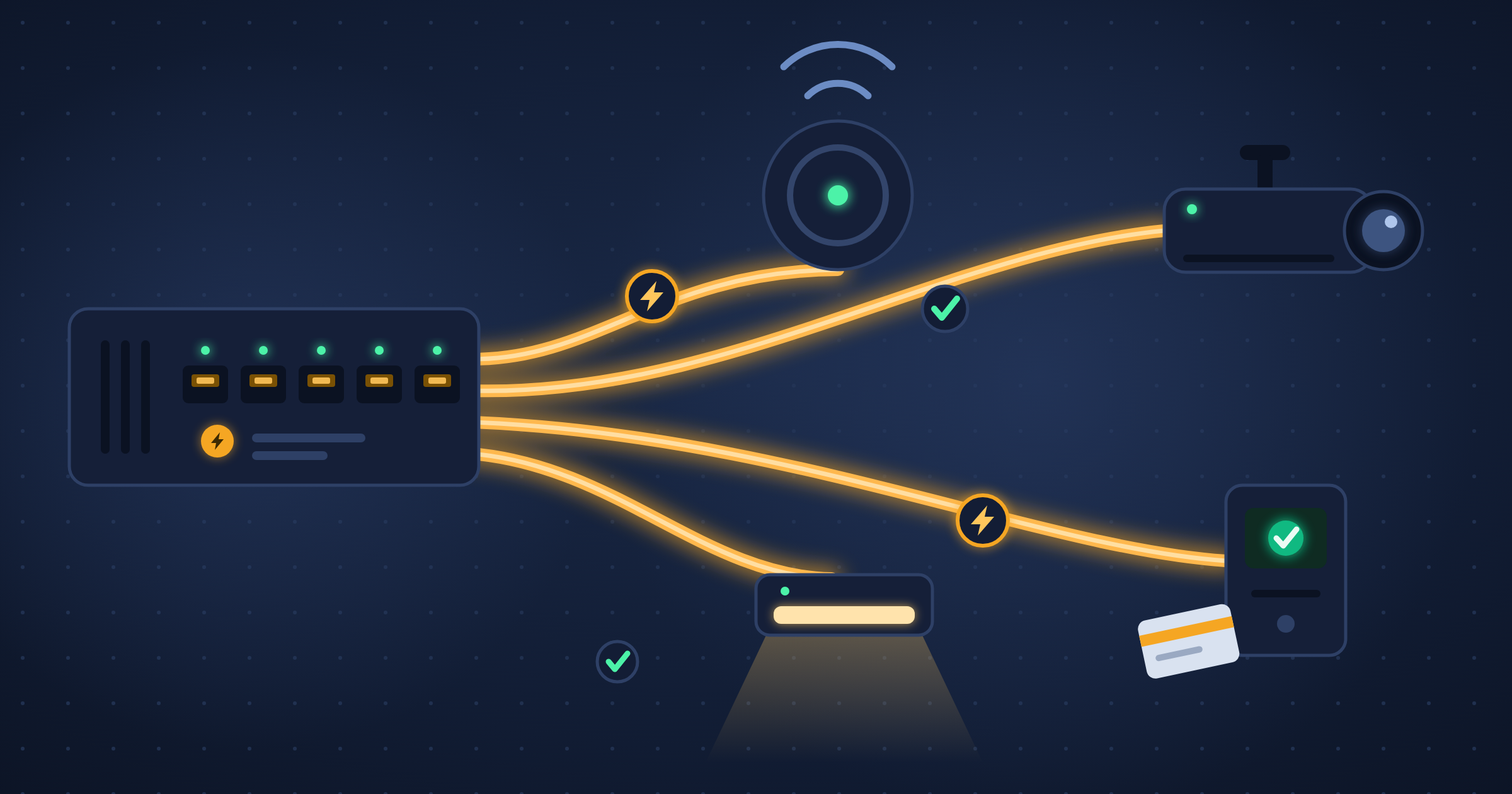
Walk through a modern commercial building and count the devices that no longer plug into a wall outlet. The security cameras. The badge readers on the doors. The wireless access points overhead. The phones on the desks. Increasingly, the lights in the ceiling. None of them are wired to a 120-volt circuit — they're powered by the same twisted-pair cable that carries their data.
That's Power over Ethernet, and over the last two decades it has gone from a niche convenience for IP phones to one of the most consequential shifts in how commercial buildings are wired. It happened quietly, one device at a time, which is exactly why so many building owners haven't fully reckoned with what it means for their infrastructure. This is that reckoning.
From 15 Watts to 90: How PoE Grew Up
The story of PoE is a story of rising power budgets, and each jump unlocked a new class of device that could finally cut its power cord.
802.3af (2003), the original "PoE": roughly 15.4 watts at the switch, about 12.95 watts delivered to the device. Enough for an IP phone or a basic wireless access point.
802.3at (2009), "PoE+": about 30 watts at the switch, roughly 25.5 at the device. Now pan-tilt-zoom cameras and hungrier access points could run on a single cable.
802.3bt (2018), "PoE++" or 4PPoE: Type 3 delivers up to 60 watts, and Type 4 up to about 90 watts at the switch — roughly 71 watts at the device — using all four pairs in the cable. This opened the door to high-power cameras, displays, and LED lighting.
Each standard didn't just add headroom. It expanded the universe of things you could power over the network.
What's Running on PoE Now
The result is a steadily growing list of building systems that have moved off the electrical panel and onto the cabling plant:
Wireless access points — and Wi-Fi 6E and Wi-Fi 7 units draw more power than the generations before them
IP security cameras, especially pan-tilt-zoom, heated, and infrared models
Access control — door controllers, card and biometric readers, electric strikes and maglocks
VoIP desk phones
Digital signage and displays
Building sensors, clocks, and a widening range of IoT devices
LED lighting — connected "PoE lighting" systems that put every fixture on the network
The pattern is consistent: anything at the edge of the building that needs modest power and a network connection becomes a candidate to move to PoE, because running one cable is cheaper and simpler than running a data cable *and* a dedicated electrical circuit with an electrician to terminate it.
Why This Is an Infrastructure Decision, Not Just a Convenience
Here's the shift that matters. When a cable only carried data, a marginal cable meant a slow or flaky connection — annoying, but rarely serious. Now that the same cable might be powering the lock on a secure door or the camera watching your loading dock, its quality has become a reliability-and-safety issue. Several things change once real power runs through the plant.
Heat. Push 60 to 90 watts through cables bundled tightly together and they generate heat. Rising temperature increases insertion loss and can derate performance — and with undersized or poor-quality cable in an already-hot space, it can become a genuine hazard. Sound design accounts for conductor gauge (23 AWG runs cooler than the thinner 24 AWG found in legacy cable), bundle size, and ambient temperature, following guidance like TIA's TSB-184-A. This is why cable category and bundling suddenly matter for *power*, not just speed.
Cable quality — and a warning about CCA. The market is full of cheap cable built with copper-clad aluminum (CCA) conductors instead of solid copper. Under PoE loads, CCA's higher resistance means more heat, greater voltage drop, and a real fire risk — and it doesn't meet the standards it's often sold as meeting. We won't install it. Under sustained power, the gap between real, tested cable and bargain cable stops being academic and starts being dangerous.
Connections and terminations. Contact resistance at a poorly terminated jack turns into heat under load, and unplugging a cable that's carrying real power can arc at the contacts. Terminations done properly, to specification, matter far more in a powered plant than they ever did in a data-only one.
Power budgets. A PoE switch has a finite power budget shared across all its ports — you can't assume every port will deliver its maximum wattage simultaneously. The switch, and the UPS behind it, has to be sized for the real load. And when that power is what keeps your doors locked and your cameras live, the switch's backup power has quietly become part of your physical security plan.
The Reframe: Your Cabling Plant Is Now a Power System
Step back and the larger consequence comes into focus. With PoE everywhere, the structured cabling system has become the backbone that both connects *and powers* the building's edge.
Centralize that power in a switch room with UPS backup and you gain something a scattering of individual plug-in adapters never offered: a single, managed, battery-backed power source for cameras, doors, wireless, and lighting — all monitored and controlled from one place. When the utility power flickers, a scatter of wall adapters goes dark; a well-designed PoE plant on a UPS keeps the building's edge alive.
But the same reframe cuts the other way. The cabling plant's quality is now load-bearing in a way it simply wasn't before. One infrastructure decision now determines both how fast your network runs and how reliably your building's edge devices stay powered. The stakes on getting the cabling right went up, even if nobody sent out a memo about it.
What's Coming Next
Two trends are worth watching closely.
PoE lighting is moving from novelty to real deployment, turning the lighting system into just another set of network endpoints — with everything that implies for data, control, and smart-building integration. When your lights are on the network, they can be scheduled, dimmed, occupancy-sensed, and monitored like any other connected device.
And beyond PoE, a newer class of fault-managed power — recognized in the 2023 National Electrical Code as Class 4 power under Article 726 — is emerging to carry far higher power, into the hundreds of watts, safely over structured-style cabling. It works by continuously monitoring the line and shutting down in milliseconds if it detects a fault, which is what makes higher voltages safe to run this way. The line between "the network" and "the electrical system" is genuinely blurring, and the cabling contractor sits squarely on that line.
How O.B. One Approaches a PoE-Ready Building
When we design and install a cabling plant, we design it for the loads it will actually carry — accounting for PoE wattage, bundle heat, ambient temperature, and pathway fill, not just data rates on a spec sheet. We use real, tested, standards-compliant cable and never CCA. We terminate every connection to specification, properly bond and ground shielded systems, and test 100% of every link to Fluke certification with a documented report.
As more of your building comes to depend on that plant for power as well as data, this discipline stops being a nicety. It becomes the difference between infrastructure you can install and forget about, and infrastructure that fails you at the worst possible moment. And we back all of it with a 100% lifetime warranty.
The Bottom Line
PoE never announced itself. It arrived one device at a time — a phone here, a camera there — until one day much of the building's edge was quietly running on network cable. That shift has raised the stakes on every cabling decision you make, whether or not it was ever discussed in those terms.
The good news is that a well-designed, properly installed, fully tested cabling plant handles it easily. The infrastructure that increasingly runs your building — its eyes, its locks, its wireless, even its lights — deserves exactly that.