
There's a costly assumption behind a lot of failed industrial networks: that wiring a plant is just wiring a bigger office. It isn't. The factory floor is one of the most hostile environments a data cable can live in, and the practices that work fine in a carpeted office park will quietly fail on a production floor — sometimes immediately, sometimes as a maddening intermittent fault that takes months to track down.
Having wired manufacturing and industrial facilities across the Southeast for four decades, we've seen the same mistakes repeated enough to name them. Here's what makes industrial cabling different, and what gets it wrong.
Heat Changes the Rules
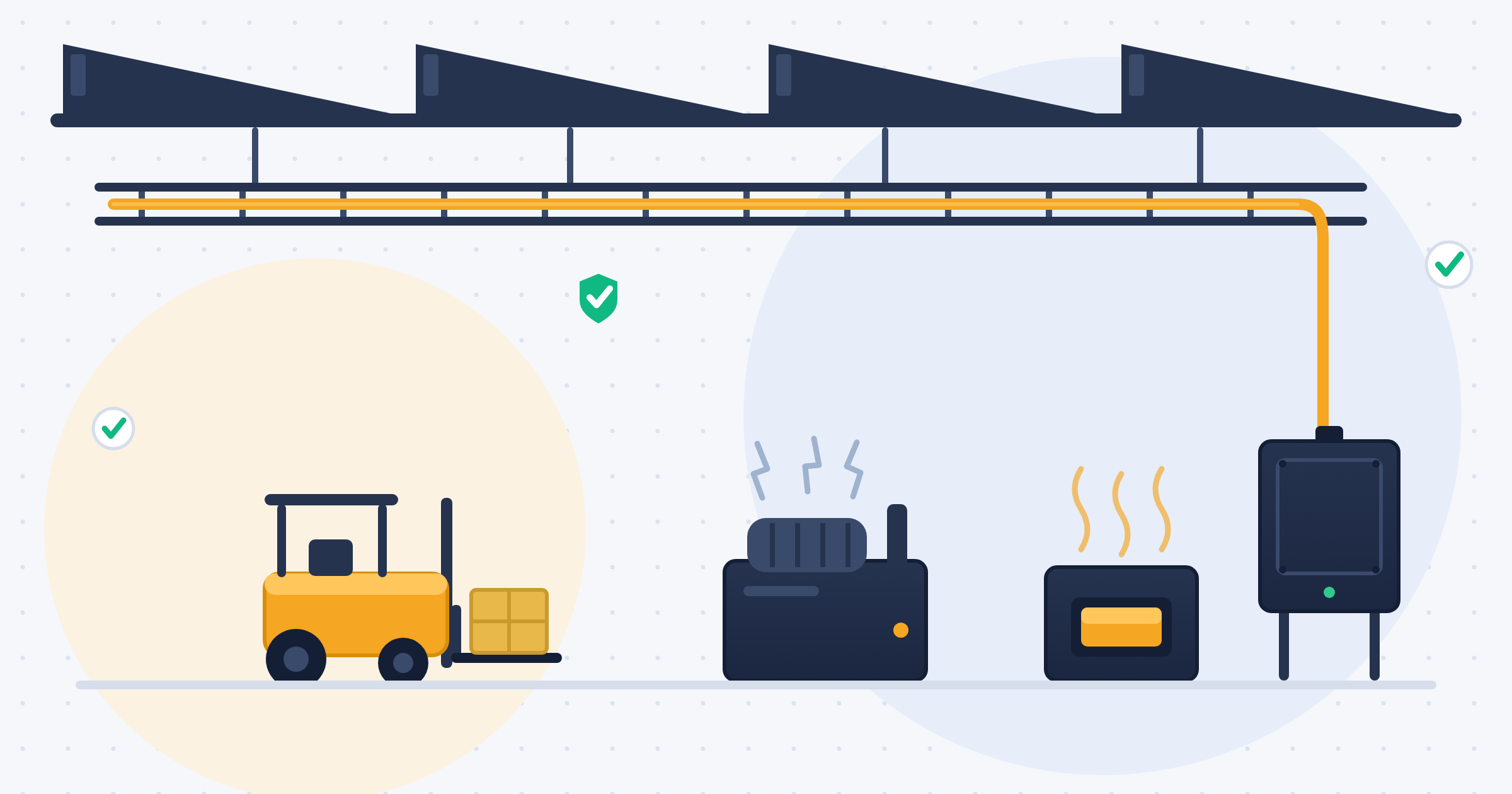
Offices are climate-controlled. Plants are not. Cable in an industrial building routinely runs through non-conditioned spaces, high open ceilings, mezzanines, and areas near ovens, furnaces, kilns, and heavy machinery — where ambient temperatures are far above what a cable in an office ceiling ever sees.
Heat matters because a copper cable's performance degrades as it warms: insertion loss rises with temperature, eating into the margin that keeps your links reliable. And if those cables are carrying PoE — powering cameras, access points, or sensors — the current adds heat of its own on top of the already-hot environment. The two effects stack.
The mistake is designing as though the cable will live at room temperature. The fix is accounting for real ambient conditions in the design: choosing appropriately temperature-rated cable, derating run lengths where the environment demands it, and factoring PoE load into the thermal math rather than pretending it's free.
Electrical Noise Is Everywhere
This is the big one, and the source of most mysterious industrial network problems. A factory floor is saturated with electromagnetic interference — from motors, from variable-frequency drives, from welders, from the large power runs feeding heavy equipment. Unshielded twisted-pair data cable acts like an antenna for all of it.
The classic error is running data cable parallel to and close alongside power conductors or machinery, because it was the convenient path. The result is corrupted data, retransmissions, dropped links, and intermittent faults that come and go with whatever equipment happens to be running — the hardest kind of problem to diagnose.
There are three defenses, and good industrial design uses them in combination: maintain proper separation between data and power runs; use shielded cable (F/UTP or S/FTP) that's *correctly bonded and grounded* — an ungrounded shield is worse than no shield; and, for the worst environments, use fiber. Fiber is glass and light — completely immune to electromagnetic interference — which is why a fiber backbone is so often the right answer for runs that cross a plant floor or pass near heavy equipment. Where copper has to go, it needs to be the right copper, installed with interference in mind.
The Floor Is Trying to Destroy Your Cable
An industrial environment is physically brutal in ways an office never is: forklift traffic, constant vibration, abrasion, impact, dust, moisture, chemical exposure, and in food and beverage or chemical plants, regular washdown. Standard cable in standard pathways doesn't survive it.
The mistake is using commercial-grade cable and open pathways and hoping for the best. The right approach matches the protection to the hazard: rugged or industrial-rated cable, sometimes armored, run in proper conduit or heavy-duty cable tray; sealed, appropriately rated enclosures (NEMA-rated for the specific dust, moisture, or washdown conditions) rather than open office-style racks; and connectors and hardware built to take the punishment — in the harshest spots, sealed industrial connectors rather than standard jacks.
Moisture, Dust, and Corrosion — Especially in the Southeast
The Southeast adds humidity to the equation, and certain industries add worse. Paper mills, chemical plants, and similar facilities carry moisture, dust, and sometimes corrosive atmospheres that attack unprotected cabling and hardware over time.
The answer is sealing the cabling from its environment — properly rated enclosures, appropriate ingress protection, and corrosion-resistant hardware where the atmosphere demands it. Cabling that's exposed to a corrosive or high-humidity environment without protection doesn't fail on day one; it degrades slowly and fails later, which makes it easy to under-build and expensive to discover.
Bonding and Grounding Aren't Optional
In an industrial setting, proper telecommunications bonding and grounding is both a performance issue and a safety one. Shielded cabling systems only deliver their interference protection when the shield is correctly bonded to a proper ground; done wrong, they can actually make things worse and introduce a safety hazard. A disciplined grounding and bonding scheme, executed to standard, is foundational on a plant floor — not a detail to be rushed at the end of the job.
The Stakes Are Higher Than in an Office
In an office, a network hiccup is an annoyance — someone reconnects to Wi-Fi and moves on. In a plant, the network increasingly runs the operation: production-line controls, machine connectivity, scanners, quality systems, safety and security. When it goes down, the line can stop — and the cost of stopped production dwarfs the cost of doing the cabling right in the first place. That asymmetry is exactly why industrial cabling deserves more rigor than office cabling, not less.
Why the Right Partner Matters on an Industrial Site
Wiring a plant well takes more than knowing how to terminate a cable. It takes designing around heat, interference, and physical hazards before the first run is pulled; it takes understanding the environment each cable will live in; and it takes working safely in an active industrial facility, around machinery and hazards, without becoming a liability on someone else's floor.
That last point is why we keep a dedicated in-house safety officer — on an industrial site, safety isn't paperwork, it's a condition of being allowed to work there at all. Our design team accounts for the heat, the noise, and the hazards specific to your facility; we test 100% of every installation and hand over the documentation; and we back the work with a 100% lifetime warranty. We've wired the plants, the mills, and the distribution centers of the Carolinas and Georgia for forty years. We know what the floor does to cable, because we've seen it.
The Bottom Line
The fastest way to end up with an unreliable industrial network is to treat the plant like a big office — same cable, same practices, same assumptions. Heat, electrical noise, moisture, and physical abuse are real engineering problems, and they have real engineering answers: the right cable, the right pathways, the right shielding or fiber, and a design that respects the environment.
Get it right and the network fades into the background and keeps the line running. Get it wrong and you'll spend years chasing faults that never should have existed.