
Everyone has experienced it: full bars in the parking lot, then you walk inside and the call drops. In a commercial building it's more than an annoyance — it's employees stepping outside to take calls, guests frustrated, point-of-sale devices on cellular backup failing, and in the worst case, no way to reach emergency services from inside the building. The reflex is to blame the carrier. Usually, the carrier isn't the problem. Your building is.
Here's what's actually happening, and what can be done about it.
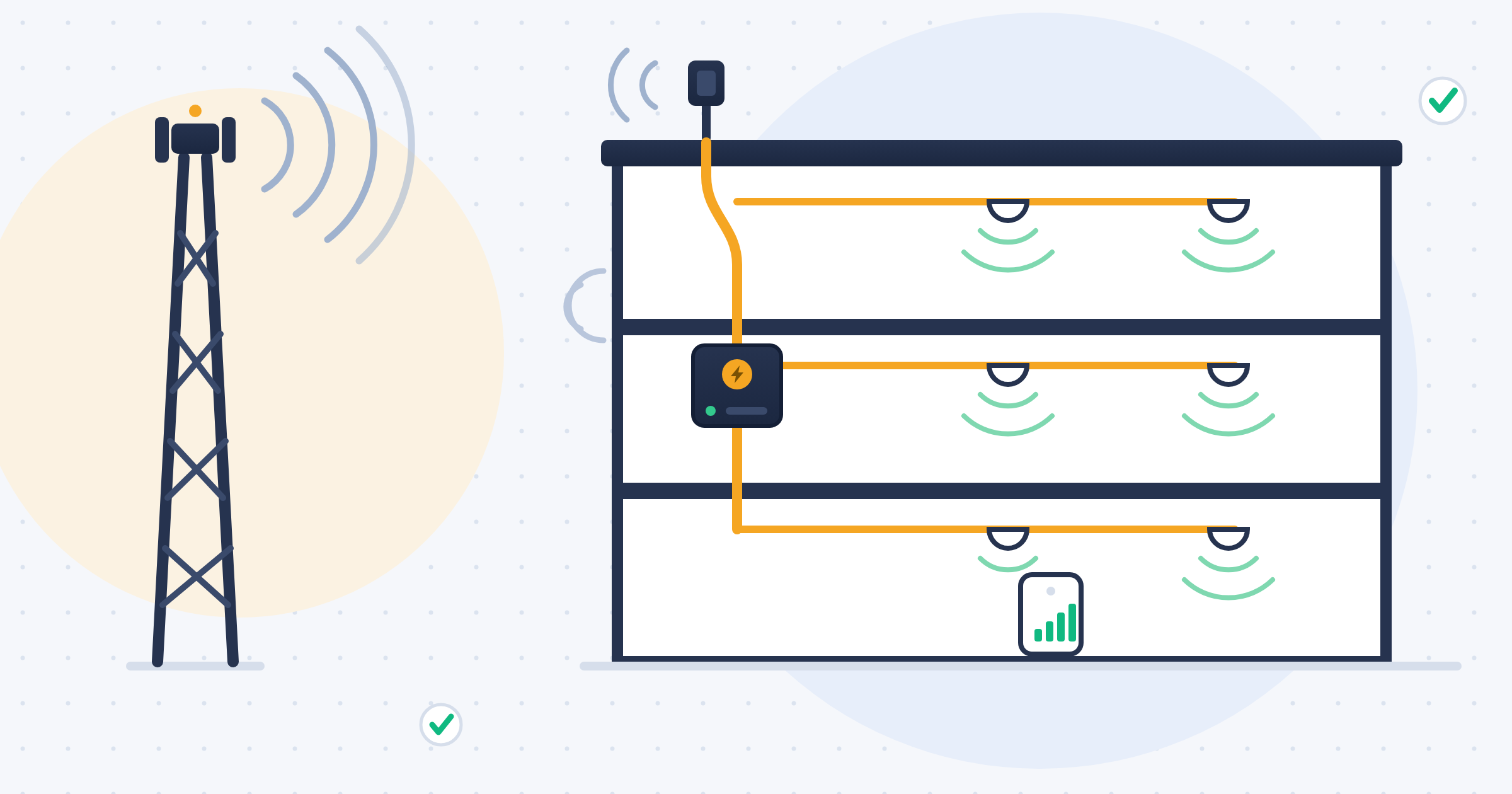
Your Building Is a Faraday Cage (a Little Bit)
Cellular signal is radio energy, and radio energy is blocked and absorbed by the materials buildings are made of. The more of those materials between you and the nearest cell tower, the weaker the signal that reaches your phone. Some of the worst offenders are exactly the things that make a building modern and efficient:
Low-emissivity ("Low-E") glass, the energy-efficient glazing in most new commercial construction, carries a microscopically thin metallic coating. It's excellent at reflecting heat — and nearly as good at reflecting cellular signal.
Concrete, masonry, and brick, especially with steel reinforcement, heavily attenuate signal.
Metal roofing, metal siding, and steel structure reflect and block radio energy.
Foil-backed insulation and radiant barriers do to cell signal roughly what they're designed to do to heat.
There's a real irony here: the more energy-efficient and well-built a building is, the worse its cell reception often becomes. The same envelope that keeps conditioned air in keeps cellular signal out.
Two other factors stack on top of construction: distance and terrain between the building and the tower, and frequency. Newer mid-band 5G and higher frequencies carry more data but penetrate buildings less effectively than the older low-band frequencies — so as networks evolve, in-building coverage can actually get harder, not easier.
The Fixes, From Simplest to Most Serious
There's no single "cell booster" that fits every building. The right solution depends on how much usable signal exists outside, how large the space is, and how many people need to use it at once.
Passive systems (bidirectional amplifiers). The most common commercial fix captures the existing outdoor signal with a donor antenna on the roof, runs it to a bidirectional amplifier (BDA) that boosts it, and redistributes it through the building via internal antennas and coaxial cable. These systems are carrier-agnostic — they amplify multiple carriers at once — and they're cost-effective. Their key limitation is that they *amplify* signal rather than *create* it: there has to be usable signal outside to begin with, and they add coverage, not network capacity. For most offices, retail spaces, and mid-sized buildings with at least some outdoor signal, this is the right tool.
Active DAS (Distributed Antenna System). For large or complex buildings — hospitals, large campuses, stadiums, high-rises — a passive booster isn't enough. An active DAS takes a stronger signal source (either off-air or, for high-capacity venues, an actual carrier base station or small cell installed on site) and distributes it over fiber and coax to remote antenna units throughout the building. Active DAS delivers far more capacity and coverage, which is why it's the standard for venues with thousands of simultaneous users. It's a larger investment and often involves the carriers directly.
Small cells. A carrier-specific mini base station that uses the building's own internet connection as backhaul. Useful in the right situation, but it typically serves a single carrier rather than everyone who walks in.
The Requirement Most Building Owners Don't Know About
Cellular coverage for your staff and customers is a productivity-and-convenience issue. There's a separate, non-optional version of the same problem: emergency responder radio coverage.
Firefighters and police rely on their own radio systems (typically in the 700/800 MHz public-safety bands) to communicate inside a building during an emergency. The same walls that block your cell signal block those radios too — which is a life-safety problem. In response, fire codes (the International Fire Code and NFPA standards) increasingly require that commercial buildings maintain a minimum level of public-safety radio signal inside, and where the building doesn't, an Emergency Responder Radio Coverage System (ERRCS) — essentially a public-safety-grade DAS with battery backup, fire-rated survivability, and monitoring — is required.
The critical point for owners and developers: whether this applies to your building is determined by your local Authority Having Jurisdiction (AHJ), and it's frequently tied to your certificate of occupancy. Buildings have failed final inspection over it. If you're building new or substantially renovating, it's a question to ask *early*, not after the drywall is up.
Why This Is Infrastructure Work
A cellular booster or DAS isn't a plug-in gadget — it's a designed system. It starts with an RF survey to measure the actual signal conditions in and around the building, then a design that places the donor antenna, amplifier, and internal antennas correctly, and finally a professional installation of the antennas and the coax or fiber that ties them together. Done casually, these systems underperform or, with amplifiers, can even cause interference that draws a shutdown notice. Done right, they turn a building full of dead zones into one with reliable coverage everywhere.
That work — RF assessment, antenna and cable design, running coax and fiber, professional installation — sits squarely in the wheelhouse of a low-voltage infrastructure contractor.
How O.B. One Approaches In-Building Coverage
We start by measuring, not guessing. An RF survey tells us what signal your building actually has to work with, which determines whether a passive booster will do the job or a larger distributed system is called for. From there we design and install the system that fits your building and your usage — the right amplifier, the right antenna placement, the coax and fiber to support it — and we do it to the standards these systems demand. If your project raises public-safety coverage requirements, that's exactly the kind of thing worth flagging and planning for before it becomes an occupancy problem. As with everything we install, the work is done to last and backed by our 100% lifetime warranty.
The Bottom Line
Cell dead zones inside a building aren't a mystery and they aren't the carrier's fault — they're a predictable result of how modern buildings are constructed. The fix ranges from a straightforward bidirectional amplifier to a full distributed antenna system, depending on the building, and the right choice starts with actually measuring the signal rather than throwing hardware at the problem. And if your building triggers public-safety coverage requirements, that's not a convenience upgrade — it's a code obligation worth getting ahead of. Either way, reliable coverage inside your walls is an achievable, designed outcome.